
Harrow Council has agreed to pay £800 and rewrite how it runs EHC plan transfers after an Ombudsman ruling. Its separate 20-week record has jumped to 87.6%.
Harrow Council has agreed to pay £800 after the Local Government and Social Care Ombudsman found it missed a legal deadline by almost a year. It has also agreed to review how it handles a key stage in every disabled child’s education.
The decision, reference 25 009 666 and dated 2 July 2026, is published in full on the Ombudsman’s website. It concerns a young person the Ombudsman calls Y, who was moving from secondary school to post-16 education in September 2024.
The Ombudsman found Harrow at fault on three points:
- it used two 2023 review meetings as the post-16 transfer review without telling the family that was their purpose, so they had no chance to prepare or to explore other settings
- it did not amend Y’s Education, Health and Care plan to name a post-16 setting by the legal deadline of 31 March 2024, which also removed the family’s right of appeal to the tribunal
- it did not arrange the special educational provision in section F of Y’s plan from September 2024, when Y had no school or college to attend
The council was cleared on one count. Records showed the school did discuss preparing for adulthood at both review meetings, which is the school’s job and the council’s duty to make sure happens.
What the record shows happened
The Ombudsman’s chronology runs from the summer before Y’s final year of secondary school:
- June 2023: Y’s mother asks for an emergency review, saying she no longer wants Y to stay at the school
- July and September 2023: two review meetings are held. The council later tells the Ombudsman these were the post-16 transfer review
- December 2023: the council starts discussing post-16 options with the family, five months after the first meeting
- May 2024: the council accepts it has not found a September 2024 placement
- 31 March 2024: the legal deadline to name a post-16 setting passes without an amended plan
- September 2024: Y starts the term with no school or college place. The mother begins paying for activities herself
- December 2024: an educational psychology assessment records that Y is still receiving nothing beyond what the mother is paying for
- February 2025: the council refunds those costs, backdated to September 2024, and starts arranging English and maths tuition
- March 2025: the council issues the amended final EHC plan, close to a year late
One widely reported line needs correcting. The Ombudsman did not find that the council’s failure left Y without a place. Y’s mother had already removed Y from the school. Had the transfer review been done properly, the investigator wrote, the council might still have named that same school, and the same disagreement could have followed. The proven injustice was uncertainty, a lost right of appeal, and five months in which a child with a legal entitlement to support received none of it from the council.
What the council has to do
Within four weeks of the final decision, Harrow must:
- apologise to Y and pay them £600 for the delay in issuing the amended final plan
- apologise to the mother and pay her £200 for the delay in arranging provision
The Ombudsman’s own guidance caps a symbolic distress payment at £500 in most cases. The investigator went above it because Y was at a key stage transfer, because Y’s plan says they need time to prepare for change, and because the uncertainty was prolonged.
Within three months, the council must review how it runs stage transfer reviews, including how it asks schools and colleges to carry them out on its behalf, and send the Ombudsman a time-bound action plan. Under the Ombudsman’s information-sharing agreement, the decision also goes to Ofsted, which already has Harrow children’s services under monitoring after an inadequate rating in January 2025.
The number that complicates the story
A ruling about 2023 and 2024 does not describe the service parents meet in 2026, and Harrow’s own published record has moved sharply.
The Department for Education measures how many new EHC plans a council issues inside the statutory 20 weeks, and published the 2025 figures on 25 June. Harrow issued 87.6% of its new plans on time in 2025, 374 of 427, against 39.3% in 2024 and 22.5% in 2023. England managed 45.5%; London managed 60.3%. That places Harrow 11th of the 33 London boroughs, and its average time to issue a plan fell to 19.9 weeks. Two plans took more than a year, down from 11 the year before.
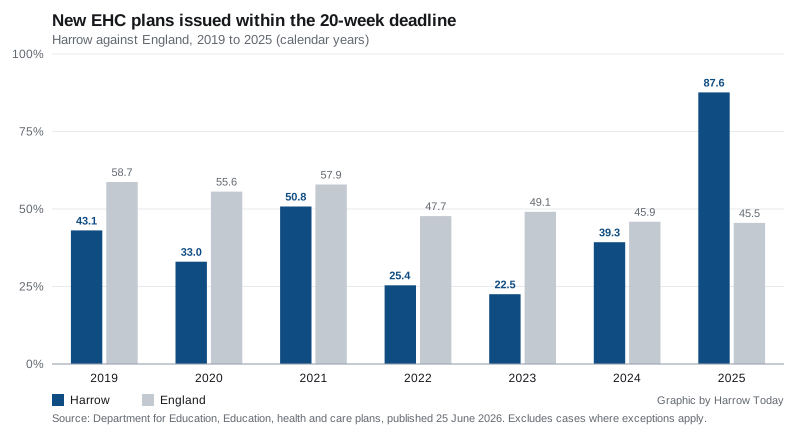
Two cautions before anyone reads that as a clean bill of health. The 20-week measure covers new plans, while this case was about a transfer review of an existing one, which is a different duty with a different deadline. And the workload behind it keeps growing: Harrow maintained 3,019 EHC plans in January 2026, up from 1,645 in 2019.
Harrow is not an outlier for complaints overall. Across the Ombudsman’s 120 most recent published decisions about the council, covering 20 March 2025 to 6 July 2026, 13 were upheld, six were not upheld and the rest were closed after initial enquiries. But every one of the three filed under special educational needs was upheld. Alongside this case, the Ombudsman found in October 2025 that the council had not completed an annual review of a plan. In June 2025 it found the council had wrongly treated a parent’s school transport concerns as a complaint, instead of offering the statutory appeal.
What it means for you
If your child has an EHC plan in Harrow, these are the deadlines the council is working to, and the ones this case turned on:
| Stage | Legal deadline |
|---|---|
| New plan, from request to final plan | 20 weeks |
| Annual review of a plan | at least every 12 months |
| Decision after a review meeting | 4 weeks |
| Amended final plan, after notice of changes | a further 8 weeks |
| Naming a post-16 setting for a September transfer | 31 March that year |
Three practical points come straight out of the decision.
Ask, in writing, what a review meeting is for. The fault here began with a review the family did not know was the transfer review. Confirming the purpose in an email creates the record.
A final plan is what unlocks an appeal. You can only appeal the named placement to the First-tier Tribunal once a final plan is issued, so a council that does not issue one is also holding up your right to challenge it.
Section F is owed whether or not there is a school place. The council accepted it arranged nothing from September 2024. The Ombudsman was clear that the duty to deliver section F provision does not pause because a child is out of school.
To complain, go through Harrow’s own complaints process first. The Ombudsman will normally only look at a case after the council has had its chance, and expects complaints within 12 months of the problem. Harrow’s SEND local offer sets out the assessment process and the SEN Assessment and Review Service that runs it.
We publish the borough’s planning decisions as they are registered on our Harrow planning news page, and the rest of the council’s record in Harrow news.
Have your say