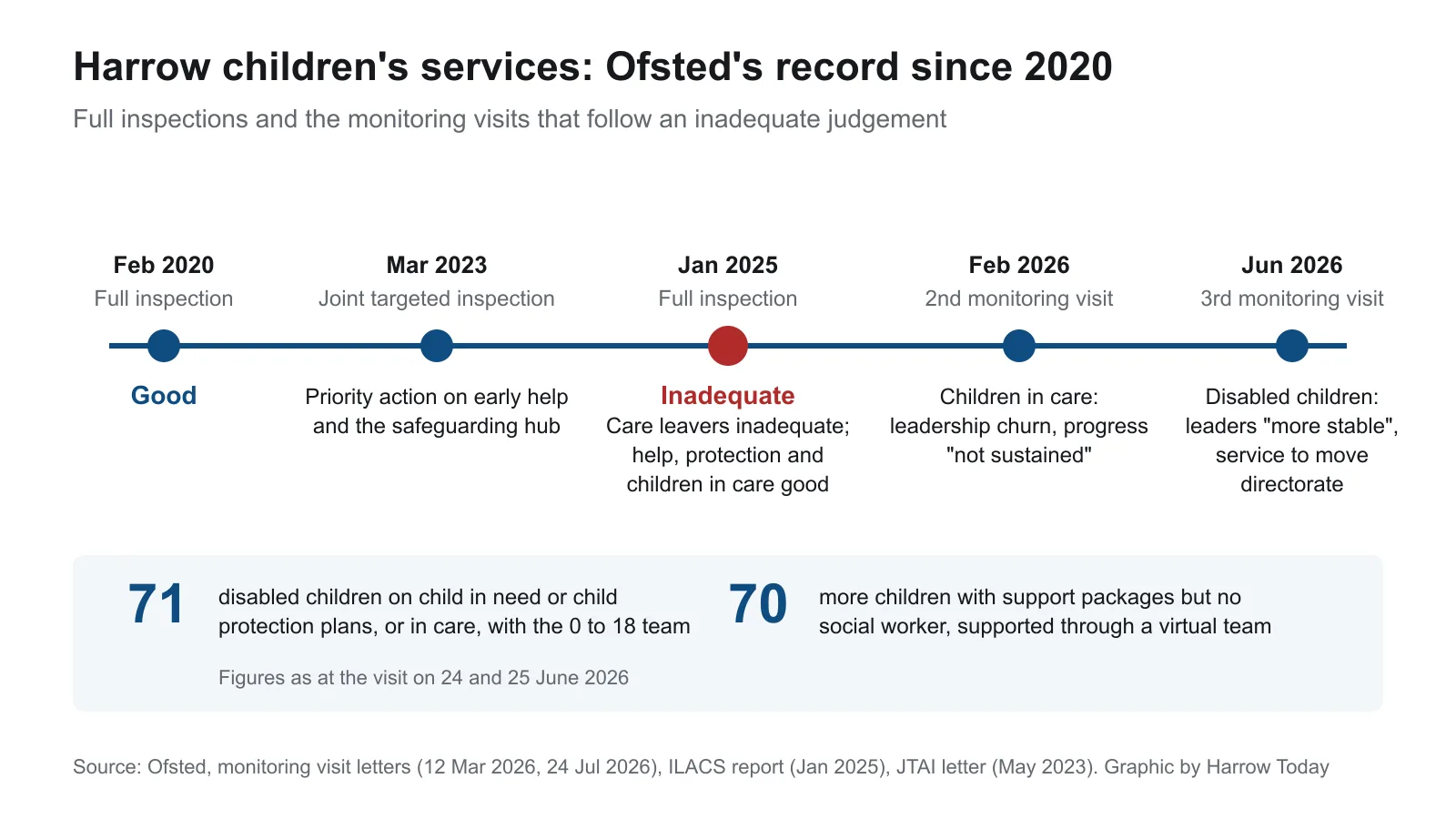

Ofsted's third monitoring visit since Harrow was rated inadequate in January 2025 finds a more stable leadership team, and a disabled children's team that will move into children's services.
Harrow Council’s children’s services, rated inadequate by Ofsted in January 2025, have a “more stable” leadership team with “an accurate understanding” of what needs to change, inspectors say in the letter from their third monitoring visit, published on 24 July 2026. The same letter records that the borough’s disabled children’s social work team is to be moved out of adult social care and into the children’s services directorate, after a council review of the service found weaknesses in assessment, planning and the timeliness of some support.
The visit, on 24 and 25 June 2026, was carried out by His Majesty’s Inspectors Jenny-ellen Scotland and Gemma McNevin and looked only at disabled children: those receiving early help or statutory assessments, those on child in need or child protection plans, disabled children in care or receiving short breaks, and young people moving into adult services. It does not change the council’s overall grade. Monitoring visits are the check-ins Ofsted makes between full inspections once an authority has been judged inadequate.
What inspectors found
The headline finding is mixed. Disabled children “benefit from committed practitioners who build positive relationships with them”, and children get “timely support when concerns are identified”, the letter says. But social work practice “does not consistently capture a comprehensive understanding of children’s lived experiences or translate into clear, child-centred planning that promotes longer-term progress”.
The specific criticisms are set out at length:
- Assessments and plans focus on a child’s support needs but “do not consistently consider their wider developmental needs, parents’ capacity to meet those needs, or the wider family and environmental factors”. For some children open to the service for a long time, assessments and plans “are not up to date”.
- Brothers and sisters of a disabled child “are not routinely seen, consulted, or included in assessments and professional discussions”, which inspectors call “a noticeable gap in current practice”. Where a sibling needs statutory support of their own, the children sit with different social workers in separate teams, which “risks fragmented planning, duplication and the loss of important information”.
- Safeguarding training: social workers “have not received recent training in key safeguarding themes, including neglect, domestic abuse, parental substance misuse and parental mental ill health”. The visit “did not identify any children living in harmful situations”.
- Delays: capacity pressures mean “some children experience delays in receiving support”, and “lengthy waiting times for CAMHS assessments” (child and adolescent mental health services, run by the NHS rather than the council) hold up the identification of need.
- Children entering care: many disabled children “enter care in crisis situations”, permanence planning “is not routinely considered early enough”, and for some very young children living in residential children’s homes “there is insufficient exploration of family-based alternatives”.
- Transition to adult services “is not consistently initiated early enough”, so plans are “not always sufficiently developed or embedded before children reach adulthood”.
- Supervision happens regularly but is “largely focused on immediate case management”, so it is not consistently used “to identify drift, to challenge practice, or to set clear actions”.
On the positive side, inspectors found “coordinated multi-agency working”, praised the co-location of occupational therapists, described “a well-established learning culture” with weekly learning sessions that staff value, and said a newly improved audit tool “is well designed”, with its section on cultural identity “providing particularly strong guidance for auditors”. Disabled children in care “benefit from developing positive relationships with their independent reviewing officers, who visit them in their homes”, though care plans “are not always updated promptly” after reviews.
The numbers
The 0 to 18 service, one of two teams in the Children and Young Adults with Disabilities Service (CYADS), supports 71 children who are on child in need or child protection plans or are in care, plus 70 more who receive support packages without a social worker through a virtual team, according to the letter. “Very few” of those children are on child protection plans.
Ahead of the visit, a small number of children with community support packages who had not been visited within expected timescales were allocated to social workers for review, a problem the letter says leaders “had identified” and “had already begun addressing”.
The service is moving directorate
The most concrete outcome is structural. The 0 to 18 team currently sits under the council’s adult social care directorate. Following what the letter calls “a comprehensive review of the service”, the council has decided to transfer it to children’s services, so that staff can use that directorate’s quality assurance framework, its social work academy and “leadership with specialist expertise in children’s services”. Inspectors say social workers “welcomed its planned integration into children’s services” and see it as better aligned with the Families First Partnership programme, the government’s reform of family help and child protection.
How Harrow got here
Ofsted rated Harrow’s children’s services good in February 2020. A joint targeted area inspection in March 2023 by Ofsted, the Care Quality Commission and the police inspectorate found the borough’s safeguarding partnership “does not have effective oversight or scrutiny” of the multi-agency safeguarding hub or early help.
The full inspection of 20 to 24 January 2025 then judged the service inadequate overall. The detail matters: help and protection, and children in care, were both rated good, but the experiences and progress of care leavers were inadequate and the impact of leaders was rated requires improvement. That report blamed “significant leadership churn, including four directors of children’s services (DCS) and two chief executives” since 2020, and found that homeless 16 and 17 year olds “do not receive the services necessary to support their well-being”.
The second monitoring visit, in February 2026, focused on children in care and was blunt about the aftermath: further leadership changes had “created instability, leaving practitioners feeling less confident and unheard”, and progress for children in care “had not been sustained since the last inspection”, although a new standalone children in care team had cut caseloads.
The July letter reads as a step on from that. Since February, the director of children’s social care has been permanently appointed as strategic director of children’s services, with recruitment under way for a permanent director of children’s social care. Inspectors write that “political leaders and the managing director remain committed to improving children’s services”, that the new strategic director and senior leaders “have a good understanding of the areas requiring improvement and have already begun implementing actions to address them”, and that workers “expressed confidence in their leaders”.
What it means for you
If your child is supported by the disabled children’s team, the practical change to watch for is the move into the children’s services directorate. The letter gives no date for the transfer; ask your social worker or the council’s children’s social care service what it means for your allocated worker and your review dates. Families of children who have been open to the service for a long time may reasonably ask when their assessment and plan were last updated, since the letter identifies that as a weakness.
If you have another child at home, the finding on siblings is worth raising directly: inspectors say brothers and sisters are not routinely seen or consulted. Nothing stops a family asking for them to be included in the assessment.
If your child is approaching 18, the letter finds transition referrals are often made too late for adult services to prepare well. Raising transition early, in your child’s mid-teens, is the direct response to that finding.
Everyone else should expect more of these letters. Ofsted continues monitoring visits until it re-inspects in full, and each one is published on the inspectorate’s Harrow provider page. The council’s other services are covered in our Harrow news section, and its planning decisions on our Harrow planning news page.
Have your say